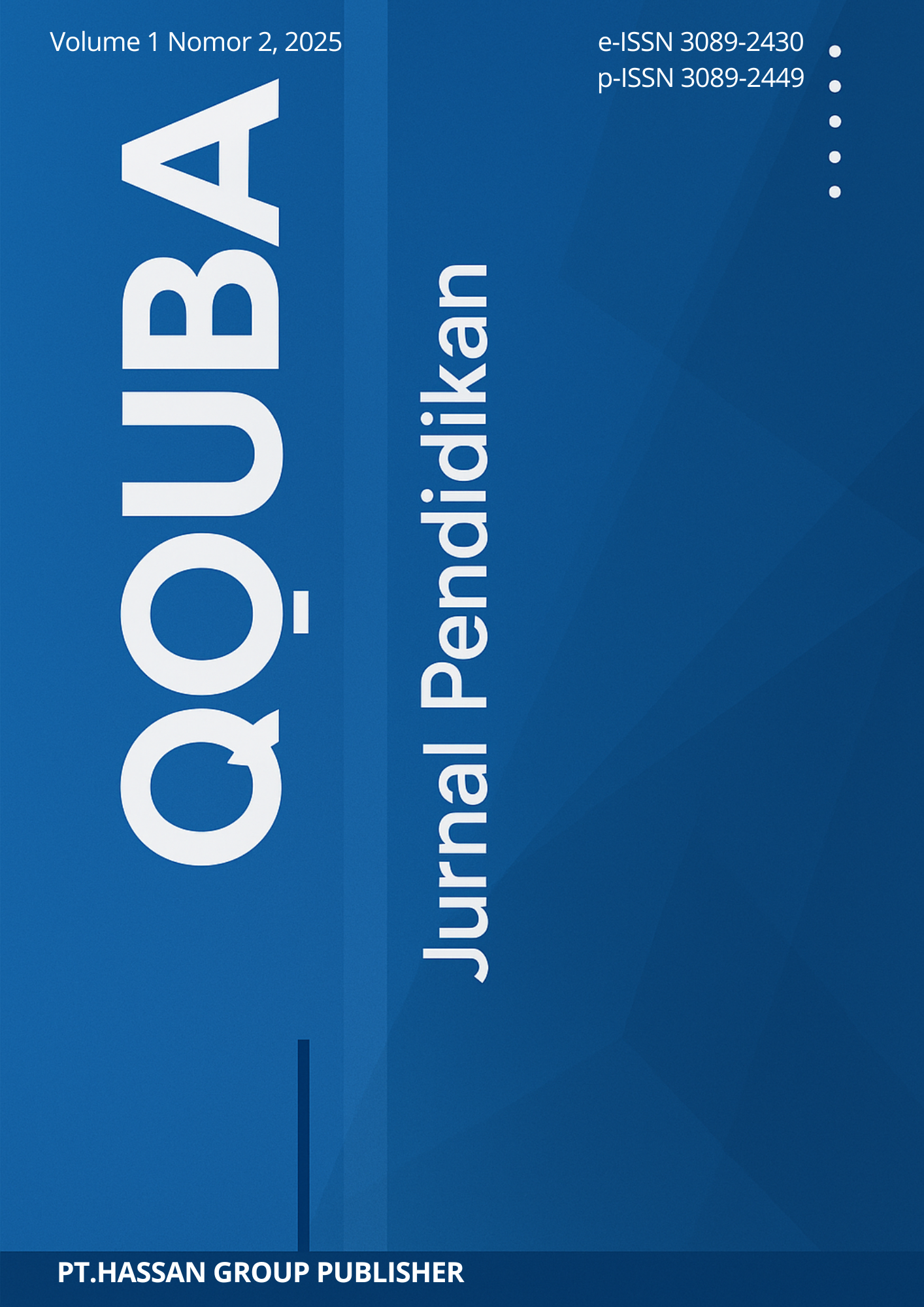
Strategi Peningkatan Minat Baca Siswa Sekolah Dasar
Studi Kasus di SD IT Ar-Raudhah
DOI:
https://doi.org/10.61104/qb.v1i2.338Keywords:
Minat Baca, Strategi Literasi, Sekolah Dasar, Budaya LiterasiAbstract
Penelitian ini bertujuan mengeksplorasi strategi peningkatan minat baca siswa sekolah dasar di SD IT Ar-Raudhah serta mengidentifikasi faktor pendukung yang berperan dalam keberhasilan program literasi. Pendekatan kualitatif dengan metode deskriptif digunakan untuk menggambarkan secara mendalam strategi yang diterapkan, melibatkan kepala sekolah, guru, dan siswa kelas IV sebagai subjek penelitian. Data dikumpulkan melalui observasi partisipatif, wawancara mendalam, dan studi dokumentasi, kemudian dianalisis dengan teknik reduksi, penyajian, dan penarikan kesimpulan, disertai triangulasi sumber. Hasil penelitian menunjukkan bahwa strategi seperti penyediaan pojok baca, literasi harian, kegiatan mendongeng, lomba literasi, pemanfaatan media digital, apresiasi pembaca aktif, dan program “Baca Bersama Keluarga” efektif meningkatkan minat baca siswa. Faktor pendukung mencakup motivasi intrinsik siswa, lingkungan sekolah yang kondusif, peran guru, keterlibatan orang tua, keberagaman bahan bacaan, dukungan teknologi, budaya literasi sekolah, kolaborasi guru, evaluasi berkala, dan kebijakan pro-literasi. Implementasi strategi berdampak pada peningkatan frekuensi membaca, pemahaman bacaan, keterampilan komunikasi, rasa percaya diri, hubungan sosial, dan prestasi akademik.
References
Arum, P. R., Wahib, A., & Anam, B. (2023). Peningkatan minat baca siswa sekolah dasar melalui pojok baca. Open Community Service Journal.
Bandura, A. (1997). Self-efficacy: The exercise of control. W. H. Freeman.
Deci, E. L., & Ryan, R. M. (2000). The “what” and “why” of goal pursuits: Human needs and the self-determination of behavior. Psychological Inquiry, 11(4), 227–268. https://doi.org/10.1207/S15327965PLI1104_01
Darling-Hammond, L., Hyler, M. E., & Gardner, M. (2017). Effective teacher professional development. Learning Policy Institute.
Duke, N. K., & Pearson, P. D. (2002). Effective practices for developing reading comprehension. In A. E. Farstrup & S. J. Samuels (Eds.), What research has to say about reading instruction (3rd ed., pp. 205–242). International Reading Association.
Emilia, N., Nur Ahyani, & Nurlina. (2024). Strategi manajemen untuk meningkatkan minat membaca siswa sekolah dasar negeri 145 Palembang. Jurnal Mahasiswa Humanis, 4(3).
Evans, M. D. R., Kelley, J., Sikora, J., & Treiman, D. J. (2010). Family scholarly culture and educational success: Books and schooling in 27 nations. Research in Social Stratification and Mobility, 28(2), 171–197. https://doi.org/10.1016/j.rssm.2010.01.002
Fullan, M. (2016). The new meaning of educational change (5th ed.). Teachers College Press.
Gambrell, L. B. (2011). Seven rules of engagement: What's most important to know about motivation to read. The Reading Teacher, 65(3), 172–178. https://doi.org/10.1002/TRTR.01024
Guthrie, J. T., & Wigfield, A. (2000). Engagement and motivation in reading. In M. L. Kamil, P. B. Mosenthal, P. D. Pearson, & R. Barr (Eds.), Handbook of reading research (Vol. 3, pp. 403–422). Lawrence Erlbaum Associates.
Guthrie, J. T., Wigfield, A., & You, W. (2012). Instructional contexts for engagement and achievement in reading. In S. L. Christenson, A. L. Reschly, & C. Wylie (Eds.), Handbook of research on student engagement (pp. 601–634). Springer. https://doi.org/10.1007/978-1-4614-2018-7_29
Hoover-Dempsey, K. V., Walker, J. M. T., Sandler, H. M., Whetsel, D., Green, C. L., Wilkins, A. S., & Closson, K. (2005). Why do parents become involved? Research findings and implications. The Elementary School Journal, 106(2), 105–130. https://doi.org/10.1086/499194
Isbell, R., Sobol, J., Lindauer, L., & Lowrance, A. (2004). The effects of storytelling and story reading on the oral language complexity and story comprehension of young children. Early Childhood Education Journal, 32(3), 157–163. https://doi.org/10.1023/B:ECEJ.0000048967.94189.a3
Jennita, M., Nazwa, A., & Rafalah, K. N. (2024). Strategi efektif dalam meningkatkan minat baca anak SD kelas rendah.
Johnson, D. W., & Johnson, R. T. (2009). An educational psychology success story: Social interdependence theory and cooperative learning. Educational Researcher, 38(5), 365–379. https://doi.org/10.3102/0013189X09339057
Krashen, S. (2004). The power of reading: Insights from the research (2nd ed.). Libraries Unlimited.
Magdalena, E. (2020). Upaya meningkatkan minat baca siswa sekolah dasar. Jurnal Pendidikan dan Konseling, 2(1).
Mol, S. E., & Bus, A. G. (2011). To read or not to read: A meta-analysis of print exposure from infancy to early adulthood. Psychological Bulletin, 137(2), 267–296. https://doi.org/10.1037/a0021890
Neuman, S. B., & Celano, D. (2012). Giving our children a fighting chance: Poverty, literacy, and the development of information capital. Teachers College Press.
Neuman, S. B., & Roskos, K. (2007). Nurturing knowledge: Building a foundation for school success by linking early literacy to math, science, art, and social studies. Scholastic.
Nurhadi. (2009). Pendidikan literasi: Strategi membaca dan menulis sekolah. Bumi Aksara.
Organisation for Economic Co-operation and Development. (2019). OECD skills outlook 2019: Thriving in a digital world. OECD Publishing. https://doi.org/10.1787/df80bc12-en
Organisation for Economic Co-operation and Development. (2021). 21st-century readers: Developing literacy skills in a digital world. OECD Publishing. https://doi.org/10.1787/a83d84cb-en
Pretorius, E. J. (2012). Reading comprehension in high-poverty schools: How should it be taught and how well does it work? Perspectives in Education, 30(1), 79–92.
Sari, A., & Susilawati, S. (2022). Pengaruh penggunaan gawai terhadap minat baca anak sekolah dasar. Jurnal Pendidikan Dasar, 13(1), 45–56.
Snow, C. E. (2010). Academic language and the challenge of reading for learning about science. Science, 328(5977), 450–452. https://doi.org/10.1126/science.1182597
Stanovich, K. E. (1986). Matthew effects in reading: Some consequences of individual differences in the acquisition of literacy. Reading Research Quarterly, 21(4), 360–407. https://doi.org/10.1598/RRQ.21.4.1
Sulistyo-Basuki. (2007). Manajemen perpustakaan dan informasi. Prenada Media.
Tarigan, H. G. (2008). Menumbuhkan minat dan kebiasaan membaca. Angkasa.
Tiara, A., & Panca, D. P. (2023). Strategi meningkatkan minat baca di kelas 4-6 melalui bimbingan dan konseling yang efektif. Universitas Ahmad Dahlan.
UNESCO. (2014). Reading in the mobile era: A study of mobile reading in developing countries. UNESCO Publishing.
United Nations Educational, Scientific and Cultural Organization. (2017). A guide for ensuring inclusion and equity in education. UNESCO Publishing.
Wasik, B. A., & Van Horn, B. (2012). The role of family literacy in society. In B. A. Wasik (Ed.), Handbook of family literacy (2nd ed., pp. 3–18). Routledge. https://doi.org/10.4324/9780203840412
Weria, J. A., & Jumriana, R. N. (2024). Cara meningkatkan minat baca siswa di era revolusi industri 4.0. JEDCHEM (Journal Education and Chemistry), 6(2).
Wigfield, A., & Guthrie, J. T. (1997). Relations of children’s motivation for reading to the amount and breadth of their reading. Journal of Educational Psychology, 89(3), 420–432. https://doi.org/10.1037/0022-0663.89.3.420
Warschauer, M. (2011). Learning in the cloud: How (and why) to transform schools with digital media. Language Learning & Technology, 15(2), 1–9.
Yuliani, N. (2016). Perkembangan anak usia dini dan strategi pengembangannya. Kencana.
Downloads
Published
How to Cite
Issue
Section
License
Copyright (c) 2025 Yuliana Ningsih, Syam Zaimar

This work is licensed under a Creative Commons Attribution-ShareAlike 4.0 International License.







 This work is licensed under a