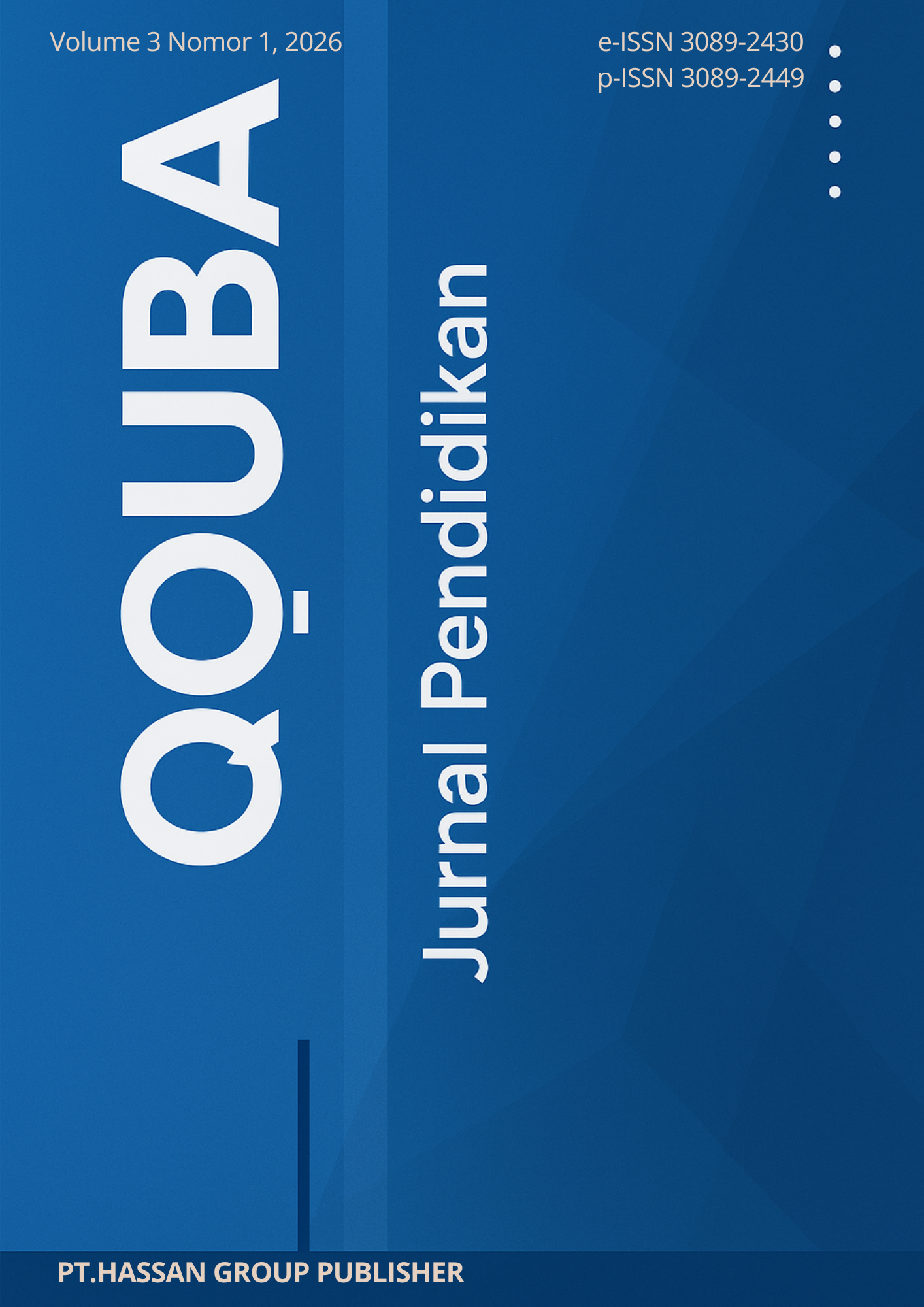
Meta-Governance Pendidikan: Integrasi Etika, Teknologi, dan Globalisasi Dalam Tata Kelola Akademik
DOI:
https://doi.org/10.61104/qb.v3i1.1209Keywords:
Meta-Governance; Tata Kelola Akademik; Etika Informasi; Transformasi Digital Pendidikan Tinggi; Globalisasi Pendidikan; Triple Helix.Abstract
Krisis tata kelola pendidikan tinggi di era digital dan globalisasi menuntut reorientasi paradigmatik dari model governance konvensional menuju meta-governance yang mengintegrasikan dimensi etika, teknologi, dan globalisasi secara sistemik. Penelitian ini bertujuan merumuskan kerangka meta-governance pendidikan yang mengakomodasi kompleksitas relasi antara negara, pasar, masyarakat sipil akademik, dan ekosistem teknologi digital dalam pengelolaan institusi perguruan tinggi. Penelitian menggunakan pendekatan kualitatif dengan metode library research, menganalisis 20 artikel jurnal bereputasi terbitan 2021–2026 serta 15 buku pakar fundamental bidang governance, network society, ethics of information, dan triple helix. Analisis tematik dilakukan melalui triangulasi lima lapis teori: Meta-Governance Theory (Jessop) sebagai grand theory, Network Governance Theory (Sørensen & Torfing) sebagai middle theory, Network Society Theory (Castells) dan Information Ethics (Floridi) sebagai supporting theory, serta Triple Helix Theory (Etzkowitz) sebagai applied theory. Hasil penelitian menunjukkan bahwa meta-governance pendidikan menuntut empat pilar integrasi: (1) etika informasi sebagai fondasi normatif kebijakan digital akademik; (2) transformasi digital sebagai instrumen pemberdayaan, bukan sekadar efisiensi; (3) internasionalisasi yang reflektif untuk menghindari homogenisasi global; (4) kolaborasi triple helix yang dikoordinsi oleh negara secara enabeling. Penelitian berkontribusi menawarkan model sintetik “Reflexive Academic Meta-Governance” yang relevan untuk konteks Indonesia dan negara berkembang lainnya dalam menavigasi ketegangan antara otonomi akademik, akuntabilitas publik, dan disrupsi teknologi.
References
Alfarizi, M., et al. (2026). World-class online university development and distance higher education governance. AAOU Journal. https://www.emerald.com/insight/content/doi/10.1108/AAOUJ-08-2025-0106/full/html
Altbach, P. G., & de Wit, H. (2021). Internationalization and global higher education governance. International Higher Education. https://ejournals.bc.edu/index.php/ihe
Asad, M. M., et al. (2026). Challenges and mitigating strategies for sustainable development of digitally transformed Community 5.0. Asian Education and Development Studies. https://www.emerald.com/insight/content/doi/10.1108/AEDS-04-2025-0167/full/html
Bjare, U. (2023). Governing by organizing: The context of universities in Sweden. Springer. https://link.springer.com/content/pdf/10.1007/978-3-031-48799-6_7.pdf
Bornemann, B., Christen, M., & Burger, P. (2025). The sustainable state: A meta-governance framework. Environmental Politics. https://www.tandfonline.com/doi/pdf/10.1080/09644016.2024.2369015
Chen, B., Wei, X., Lou, S., et al. (2026). Governing collaborative technological innovation for net-zero transition. Sustainability, 18(3), 1509. https://www.mdpi.com/2071-1050/18/3/1509
Dhrubo, A. M. (2026). The moral authority of the firm: Rethinking organizational legitimacy beyond profit and compliance. Philosophy of Management. https://link.springer.com/article/10.1007/s40926-026-00382-6
Fernández, A., et al. (2023). Digital transformation initiatives in higher education institutions. Education and Information Technologies. https://link.springer.com/article/10.1007/s10639-022-11544-0
Joecks, L., & Hartong, S. (2026). Beyond products and policies: Transformative consultancy for schooling in the digital age. Learning, Media and Technology. https://www.tandfonline.com/doi/pdf/10.1080/17439884.2026.2630186
Kang, L., & Xu, X. (2025). Progress and prospect of digital transformation of higher education in China. Globalisation, Societies and Education. https://journals.sagepub.com/doi/10.1177/14779714241300086
Leal Filho, W., et al. (2024). Digital transformation and sustainable development in higher education. Environment, Development and Sustainability. https://link.springer.com/article/10.1007/s10668-023-04000-9
Magalhães, A., Amaral, A., & Antonowicz, D. (2026). Coping with the flow-state mediation in European higher education. Globalisation, Societies and Education. https://www.tandfonline.com/doi/pdf/10.1080/14767724.2025.2610640
Nazyrova, A., et al. (2025). The digital transformation of higher education in an AI-driven future. Sustainability, 17(22), 9927. https://www.mdpi.com/2071-1050/17/22/9927
Pan, X., & Park, J. Y. (2026). State-directed evaluative coordination: The transformation of university governance in South Korea. https://www.sciencedirect.com/science/article/pii/S3117763826000079
Ricartti-Villagrán, A. E., et al. (2026). Impact of educational managers competencies and leadership styles on digital transformation and quality in higher education. Frontiers in Education. https://www.frontiersin.org/articles/10.3389/feduc.2026.1700517/full
Ruano-Borbalan, J. C. (2025). Openness, innovation, and the reflexive university: Rethinking knowledge governance. European Journal of Education Policy and Management. https://www.aup-online.com/content/journals/10.5117/EJEP2025.1.004.RUAN
Snelson-Powell, A., Defazio, D., & Dimov, D. (2025). Navigating digital transformation in international higher education: An EdTech mapping of the emerging global educational ecosystem. Emerald. https://www.emerald.com/books/edited-volume/17979/chapter/98879118
Ukeje, I. O., et al. (2026). Digitally transforming higher education through a stakeholder-driven co-governance model. Innovative Higher Education. https://link.springer.com/article/10.1007/s10755-025-09861-6
Zhang, B., Hu, Q., & Gou, S. (2026). University-government collaboration and meta-governance in teacher education. Sustainability, 18(2), 584. https://www.mdpi.com/2071-1050/18/2/584
Articles in Higher Education (Springer). https://link.springer.com/journal/10734 ; Studies in Higher Education. https://www.tandfonline.com/toc/cshe20/current
Referensi Buku Pakar (15 sumber)
Altbach, P. G., Reisberg, L., & de Wit, H. (2021). International higher education. Boston College.
Barnett, R. (2011). Being a university. Routledge.
Barnett, R. (2013). Imagining the university. Routledge.
Bevir, M. (2011). The SAGE handbook of governance. Sage.
Castells, M. (2010). The rise of the network society (2nd ed.). Wiley-Blackwell.
Christensen, C., & Eyring, H. (2011). The innovative university: Changing the DNA of higher education from the inside out. Jossey-Bass.
Etzkowitz, H. (2008). The triple helix: University-industry-government innovation in action. Routledge.
Floridi, L. (2013). The ethics of information. Oxford University Press.
Floridi, L. (2014). The fourth revolution: How the infosphere is reshaping human reality. Oxford University Press.
Fullan, M. (2020). Leading in a culture of change (2nd ed.). Jossey-Bass.
Jessop, B. (2016). The state: Past, present, future. Polity Press.
Mintzberg, H. (2009). Managing. Berrett-Koehler.
Schwab, K. (2017). The fourth industrial revolution. Crown Business.
Senge, P. (2006). The fifth discipline: The art and practice of the learning organization (rev. ed.). Doubleday.
Sørensen, E., & Torfing, J. (Eds.). (2007). Theories of democratic network governance. Palgrave Macmillan.
Downloads
Published
How to Cite
Issue
Section
License
Copyright (c) 2026 Reno Pardiansyah, Said Maskur, Muhammad Faisal

This work is licensed under a Creative Commons Attribution-ShareAlike 4.0 International License.






 This work is licensed under a